Breaking Barriers in the Water: A Q&A with Our Deaflympics Gold Medallist Swim Teacher
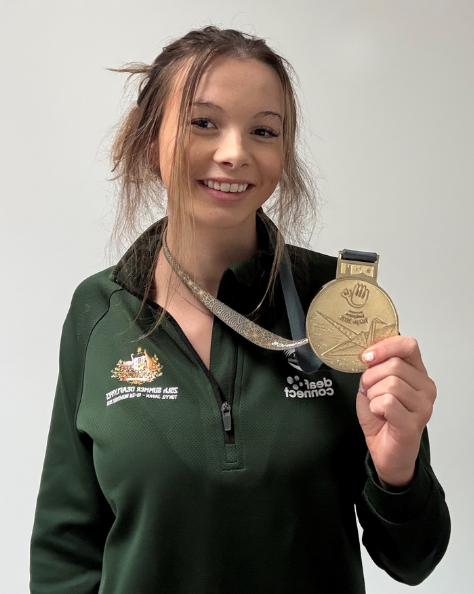
Meet Imogen, one of our swim teachers at Ivanhoe Swim – and Australia’s 2025 Deaflympics flag bearer. From being turned away from learn-to-swim programs as a child to winning gold in Japan, her journey is one of resilience, advocacy, and a deep love for the water.
Can you tell us a bit about your journey into swimming – how did it all begin for you?
Being deaf, I was actually rejected from a few learn to swim programs due to the misconception that it would be unsafe. Thankfully, my parents really understood how important swimming was, so they kept searching for other options. I was first introduced to the water through my kindergarten teacher, who also happened to be a swim teacher. At that stage, it was just basic water familiarisation. However, when he eventually left, we couldn’t find another teacher, and I began to struggle in larger swim classes where strokes were being taught and there was limited communication support for me.
Because of this, my parents decided to take a break from swim lessons for a period of time. That changed when they found a flyer and contacted Katrina (Director of Aquatics at Ivanhoe Swim), who then connected us with a swim teacher who knew Auslan.
From that point on, I was able to have one on one lessons with a teacher I could fully understand. From there, I was able to learn properly and progress through swimming. I started doing well at school carnivals, which eventually led me into a squad environment and more competitive swimming.
How has being deaf shaped your experience in the sport – both the challenges and the strengths it’s given you?
My journey has definitely taught me how to adapt and advocate for myself, while also allowing me to meet so many people along the way. Being deaf may present disadvantages in terms of fairness and access, but not in ability.
In terms of sport specifically, one of the main challenges is communication, especially in fast-paced environments like training and racing, where I rely heavily on visual cues instead of sound. But that has also built strengths like focus, resilience, and adaptability, which is why having the right access and support is so important.
I primarily race against hearing athletes, and through that I’ve been able to challenge and shift people’s perceptions of what it means to be deaf. Rather than being seen as different or limited, I’m seen as a competitor, and that’s really important to me. It shows that with the right opportunities and access, anyone whether hearing or deaf can achieve their goals.
It also makes me really reflect on how lucky I am with the opportunities I’ve had. I’ve faced challenges, but I’ve also been inspired a former Australian deaf athlete, Cindy Lu Bailey who competed at both the Deaflympics and mainstream Commonwealth Games in the 1980s. This was a time where she didn’t have access to things like starter lights, waterproof hearing devices, or even the ability to sign with others at the time. Hearing her story really puts things into perspective and motivates me to keep pushing forward.
Overall, it’s made achieving my goals even more meaningful.
You represented Australia at the 2025 Deaflympics in Japan and were chosen as the flag bearer. What did that honour mean to you?
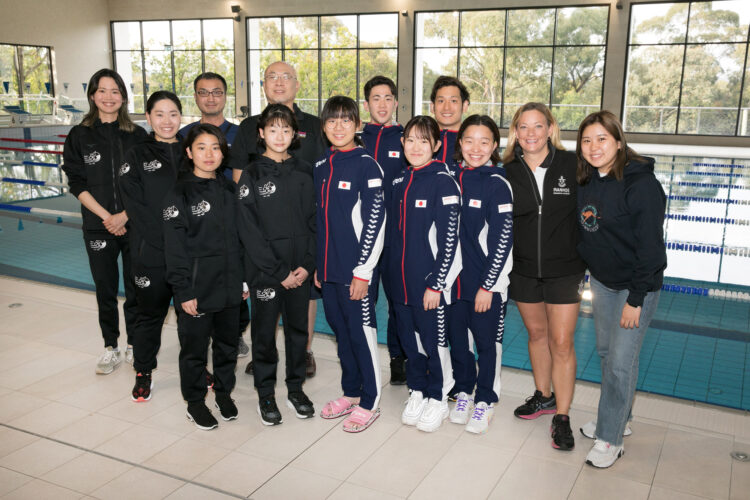
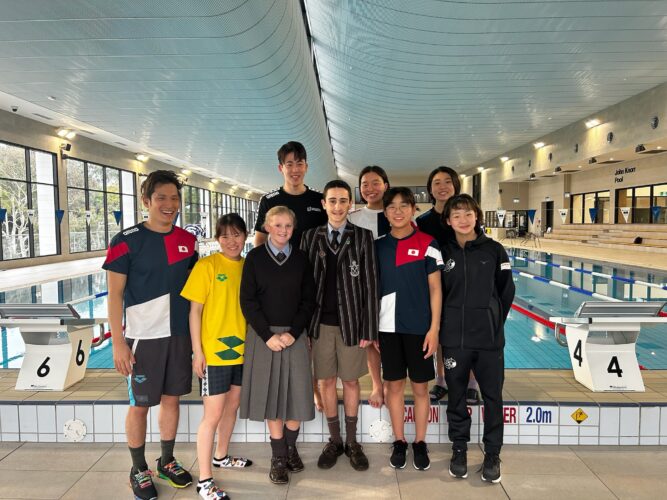
Representing Australia at the 2025 Deaflympics in Japan was an incredible experience. I was able to meet many different deaf athletes from all over the world, and there were also athletes who had competed at the Paris 2024 Olympics, which was really inspiring and an amazing achievement to see up close.
Being chosen as flag bearer was a really special experience. I was chosen as i was the only medalist for Australia across all the sports; though it was amazing to see so many countries come together, and it highlighted how strong and connected the wider deaf community is. It also really showed the huge progress that has been made, but also the challenges that still exist in terms of access and opportunity in sport.
What was the atmosphere like at the Deaflympics, and is there a moment from the Games that stands out as especially meaningful?
The atmosphere at the Deaflympics was incredible. Because everyone is deaf or hard of hearing, it felt a lot more equal and connected, especially in the way competitions were run. All athletes had access to visual starting systems, including lights, which made a huge difference.
In Japan solely for the Deaflympics , they used a traffic light system; Green meant get on the blocks,Orange meant take your marks, and Red meant go. This was actually much more advanced compared to some competitions in Australia, where often only a single light is used just to signal the start. While that’s still helpful, it doesn’t fully support deaf athletes in being prepared for each stage of the start, which can affect reaction time and performance. Having a full system like in Japan made me feel much more included and able to perform at my best, which I was able to achieve a gold medal for my 50 breaststroke and 2 silvers for my 100, and 200 breaststroke.
There were also very clear systems in place around fairness on pool deck, including strict rules about when you were allowed and not allowed to wear or have hearing devices, which helped ensure equality across all athletes.
I felt both nervous and excited for my races, but what I really loved was meeting athletes from so many different countries and seeing how they advocate for themselves in their own environments. It was really inspiring.
Some athletes who stood out to me were Carli Cronk, who has made USA Olympic trials finals and holds multiple deaf world records. I also met Matthew Klotz, who has used platforms like the show ‘Big Brother’ to advocate for deaf athletes and visibility in sport. From Italy, there was Viola, who has competed at the 2024 Paris Olympics, and I also had the chance to meet Terrence Perkins, who won a silver medal at the Sydney 2000 Olympics and has competed many times across both mainstream Olympics and Deaflympic environments.
Seeing all these different journeys really inspired me and made the experience even more meaningful.
What inspired you to become a swim teacher, and what do you enjoy most about coaching at Ivanhoe Swim?
I started swim teaching because I’ve always wanted to work with children and help create more equal access in swimming, especially for those who may face barriers in learning. While I work with a wide range of students; including mainstream swimmers, children on the spectrum, and those with other disabilities. I’m really aware that deaf children can sometimes struggle due to limited visual communication or a lack of understanding of deaf awareness in some environments.
Before becoming a swim teacher, I wanted to try and help bridge that communication gap between swim teachers and deaf students. I contributed by providing basic Auslan signs for the ‘Puggles’ program, which is designed for teachers who may have deaf students. While I knew this doesn’t fully solve the communication barrier, it felt like a small step I could take to help improve understanding and inclusion. However, being deaf myself, I am both fluent in English and Auslan. I am flexible to how a deaf child may prefer how to communicate, whether that be visual (Auslan), verbal, or a combination of both. I feel that having this flexibility helps create a more inclusive and supportive learning environment for deaf individuals.
What I enjoy most about swim teaching at Ivanhoe Swim, is seeing students progress and gain confidence in themselves over time. It’s really rewarding to watch them grow not just in skill, but building confidence within themselves.
Additionally, I feel that Ivanhoe Swim is not only very accommodating for those who work there ( including myself), but also provides a supportive and inclusive environment for each individual learner. With access to different types of pools and learning spaces, students are able to develop at their own pace and build new skills in a way that best suits their needs.
How do you adapt communication in the pool to make learning clear, fun, and effective for your students?
Being deaf myself, I have first hand experience of how challenging it can be when there is a lack of clear communication. Because of that, I’m very aware of how important it is to make sure instructions are accessible and easy to understand for every student.
In the pool, I make sure I’m always facing the student when communicating, and I adjust my approach depending on how they best receive information. If a student was to primarily use Auslan, I can communicate fully in Auslan, which would allow me to explain activities clearly and also gives them the ability to express themselves and understand without communication barriers.
I also try to make lessons engaging by incorporating games, but still linking them to a specific skill so there is always a learning outcome. This helps students progress while still having fun, which makes the lesson more enjoyable and effective.
What advice would you give to young swimmers – or deaf children – who are just starting out?
My biggest piece of advice would be to advocate for yourself, or for your child, to make sure you’re getting the right access and support you need. Speaking up and communicating what works best for you/ your child can make a huge difference in ensuring everyone is included properly in their learning.
I also think it’s really important for all children, including deaf children, to learn how to swim. It’s such an essential life skill, particularly for safety reasons, and it’s something that can be taken with you anywhere in life. That’s why getting children into swim lessons early is so important, not just for skill development, but for confidence and safety in the water as well.
Looking ahead, what goals or dreams are you excited to pursue next – whether in your competitive career, your coaching, or your personal life?
Looking ahead, I’m really excited for the upcoming Commonwealth Trials at the end of Term 2, where I’ll be competing in the 50m,100m, and 200m breaststroke. I’m really looking forward to the experience and the opportunity to race at a high level again.
Beyond my competitive swimming, I also want to continue working towards improving inclusion for deaf swimmers. I’m really passionate about helping close the barriers that deaf people can face in swimming, especially around communication and access. I want to keep contributing to making the sport more inclusive so that deaf swimmers have equal opportunities to learn, compete, and succeed.